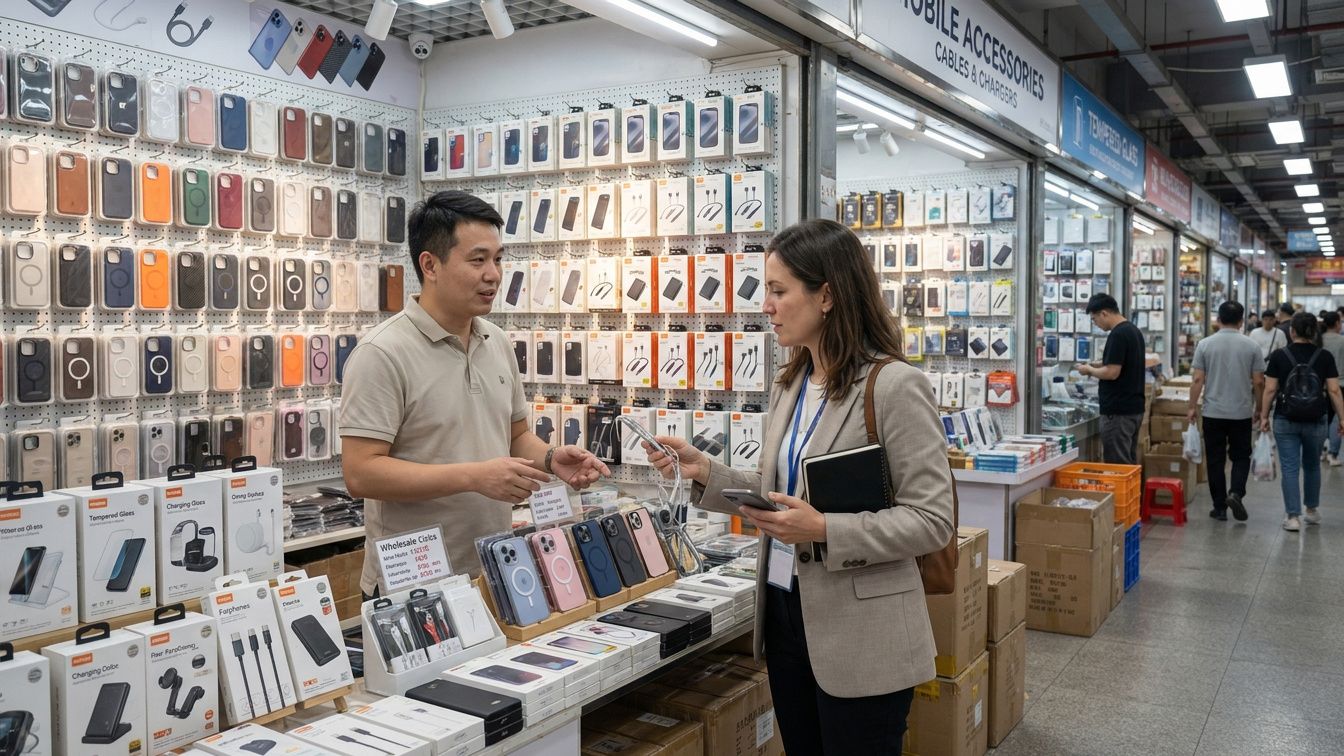
Buying phone accessories from China can offer overseas businesses access to a wide range of products and suppliers. But finding a product online and placing a wholesale order are two very different things.
A phone case may look perfect in a product photo, but does it fit the exact phone model? Is the material what you expected? Does the magnetic function work properly? And does the quoted price include the packaging and shipping costs you need to consider?
These details matter, especially for wholesalers, importers, distributors, and retailers who need products they can sell with confidence.
Before requesting a quotation or placing an order, here are eight things worth checking.
1. Be Specific About the Product You Need
One of the most common problems in product sourcing is starting with a request that is too general.
For example, asking for "iPhone cases" does not give a supplier enough information to provide an accurate quotation.
There are many variations, including:
- Clear phone cases and transparent cases
- Magnetic phone cases
- Shockproof and protective cases
- Leather-style and silicone cases
- Acrylic, PC, TPU, and hybrid-material cases
- Cases with stands, rings, or other additional features
Even two products that look similar in photographs may have different materials, construction, and costs.
Before contacting a supplier, decide what type of product you are looking for. Reference photos, product links, and examples of similar items can make communication much easier.
The more clearly you describe the product, the less time you will spend correcting misunderstandings later.
2. Check Phone Model Compatibility Carefully
Compatibility is particularly important when sourcing mobile phone accessories.
A product advertised as an iPhone case may not fit every iPhone model. Differences in camera openings, button positions, dimensions, and other details can make a case incompatible with a particular device.
For bulk orders, confirm the exact models you need.
For example, instead of requesting an iPhone case in general, specify the required models, such as:
- iPhone 16 Pro
- iPhone 16 Pro Max
- iPhone 17 Pro
- iPhone 17 Pro Max
Also consider whether you need features such as magnetic accessory compatibility, wireless charging support, camera protection, or a built-in stand.
Do not assume that a supplier's general product description covers every variation. Ask for confirmation of each model before approving samples or ordering in quantity.
This is also important for screen protectors, charging accessories, and other model-specific products.
3. Confirm Materials, Features, and Product Specifications
Product photographs are useful, but they do not tell you everything.
Two phone cases may have almost identical appearances while using different materials. One may have a flexible TPU structure, while another uses a combination of PC and TPU.
These differences can affect the product's appearance, feel, durability, and selling price.
For each product, try to confirm:
- Main materials and construction
- Available colors and designs
- Dimensions and product weight
- Functional features
- Compatible phone models
- Included accessories
- Packaging specifications
For electronic accessories, the specification list may need additional details, such as battery capacity, charging specifications, connection type, or supported functions.
It is worth keeping these details in a written product specification sheet.
When you compare quotations from different suppliers, make sure you are comparing products with equivalent specifications. Otherwise, the lowest quotation may not represent the best value.
4. Request Samples Before Committing to a Larger Order
Product photos and descriptions cannot fully replace a physical sample.
A sample gives you an opportunity to check the actual product rather than relying entirely on what is shown online.
For phone cases, you may want to examine:
- Whether the case fits the correct phone model
- Whether the buttons and charging port are accessible
- Whether the camera opening is correctly positioned
- Whether the material and finish match your expectations
- Whether the product feels comfortable to hold
- Whether additional functions work as described
For other electronic accessories, testing should be based on the product's actual functions and intended use.
If you are sourcing several designs or variations, do not assume that checking one sample automatically verifies all the others.
Before approving a sample, record which product model, color, material, and version you have checked. This gives both sides a clearer reference when discussing the bulk order.
5. Understand the Full Wholesale Quotation
The unit price is important, but it should not be the only factor in your purchasing decision.
A quotation needs to provide enough information for you to calculate the actual cost of buying the products.
When requesting a wholesale quotation, consider asking for:
Quotation Item
What to Confirm
Unit Price
Price per piece and currency
MOQ
Minimum quantity per product or variation
Sample Cost
Whether samples are charged separately
Packaging
Standard packaging and customization costs
Customization
Logo, color, or packaging options, if available
Production Time
Estimated time after specifications are confirmed
Shipping
Available shipping methods and estimated costs
Payment
Accepted payment method and payment arrangements
One detail that is sometimes overlooked is whether the quotation is based on the same delivery terms.
For example, an EXW quotation and an FOB quotation do not represent the same cost arrangement. Make sure you understand what is included and excluded before comparing suppliers.
It is also useful to ask how long the quotation remains valid, especially when product prices or material costs may change.
A clear quotation makes budgeting easier and reduces the risk of unexpected costs.
6. Check Product Compliance and Required Documentation
This step deserves particular attention when purchasing electronic products for overseas markets.
Different products may be subject to different regulatory, safety, labeling, and documentation requirements depending on their design and destination.
For example, a basic phone case and a wireless electronic accessory do not necessarily have the same compliance considerations.
Products involving batteries, wireless communication, charging functions, or power adapters may require additional checks.
Before placing an order, consider:
- What requirements apply in the destination market?
- Does the product need testing or supporting documentation?
- Are the available documents relevant to the exact product model?
- Are the product labels and packaging appropriate for the intended market?
- Who is responsible for verifying compliance before importation?
If a supplier provides a certificate or test report, check that it actually relates to the product you intend to purchase. A document for a different model or product should not automatically be treated as valid for your order.
For US-bound shipments, buyers should identify the applicable federal and product-specific requirements before importing.
When the requirements are unclear, obtain advice from a qualified compliance professional rather than relying solely on a supplier's product listing.
7. Agree on Quality Checks Before Shipment
Quality expectations should be discussed before production, not after products arrive.
A useful starting point is an approved sample. It gives both the buyer and supplier a physical reference for the expected product.
You should also consider agreeing on:
- Acceptable product appearance and finish
- Material and color consistency
- Functional testing requirements
- Packaging condition
- Quantity verification
- How defective or incorrect items will be handled
For a larger order, you may want to arrange a pre-shipment inspection.
The inspection method and acceptance criteria should be agreed in advance. Simply asking a supplier to provide "good quality products" is not a precise quality standard.
It is much easier to resolve differences when specifications, approved samples, and inspection expectations are documented before shipment.
8. Calculate the Total Cost, Not Just the Product Price
A low factory or supplier price does not always mean a low final purchasing cost.
For overseas buyers, the total landed cost may involve several different expenses:
- Product purchase cost
- Sample and customization expenses
- Domestic transportation in China
- Export-related charges
- International shipping
- Customs duties and applicable taxes
- Destination handling and final delivery
The actual cost depends on the product, shipment size, destination, and delivery arrangement.
For smaller orders, international express or air shipping may be worth comparing. For larger shipments, other transportation options may offer a different cost structure.
It is also important to confirm who is responsible for customs clearance, import duties, and final delivery.
Before choosing a supplier, compare the complete purchasing and delivery arrangement rather than looking at the unit price alone.
A Simple Checklist Before Requesting a Quotation
Good product information makes the sourcing process more efficient.
When contacting a supplier or sourcing partner, try to prepare the following details:
Information
Example
Product
Magnetic phone case
Compatible Model
iPhone 17 Pro Max
Material
PC + TPU
Color
Black, Blue, Clear
Quantity
Estimated quantity per color
Special Features
Magnetic compatibility, camera protection
Packaging
Individual retail packaging
Customization
Logo printing, if required
Destination
United States
Reference
Product photos or reference links
You do not need to know every detail before making an inquiry. However, providing as much information as possible will help suppliers understand your requirements and prepare more useful quotations.
Working with a China-Based Sourcing Partner
For overseas businesses, sourcing products from China can involve more than finding a supplier and asking for a price.
You may need to compare products from different suppliers, clarify specifications, review quotations, coordinate sample requirements, and keep track of order details.
This is where a sourcing and supply partner can be useful.
ASEBK works with overseas businesses looking to source consumer electronics and accessories from China. Our role is to coordinate with suppliers, compare available product options, handle quotation requests, and organize order-related details.
We operate as a B2B sourcing and supply partner rather than claiming to manufacture every product directly. Product specifications, supplier pricing, sampling arrangements, and production details are confirmed with the relevant supplier according to each inquiry.
Whether you are looking for phone cases, screen protectors, mobile accessories, or other consumer electronics products, having clear purchasing requirements is a good starting point.
You can explore the ASEBK product catalog or contact our team with your product requirements to discuss a sourcing inquiry.
Final Thoughts
Successful sourcing is not simply about finding the cheapest product.
It is about understanding exactly what you are buying, confirming that the product meets your requirements, comparing quotations fairly, and knowing the costs involved before placing an order.
A little preparation at the beginning can save considerable time and reduce unnecessary problems later.
For wholesale buyers, a clear product specification and a well-organized quotation are often the best places to start.